Actuator Reality Shaping
for Zero-Shot Sim-to-Real Robot Learning
Abstract
Key Idea
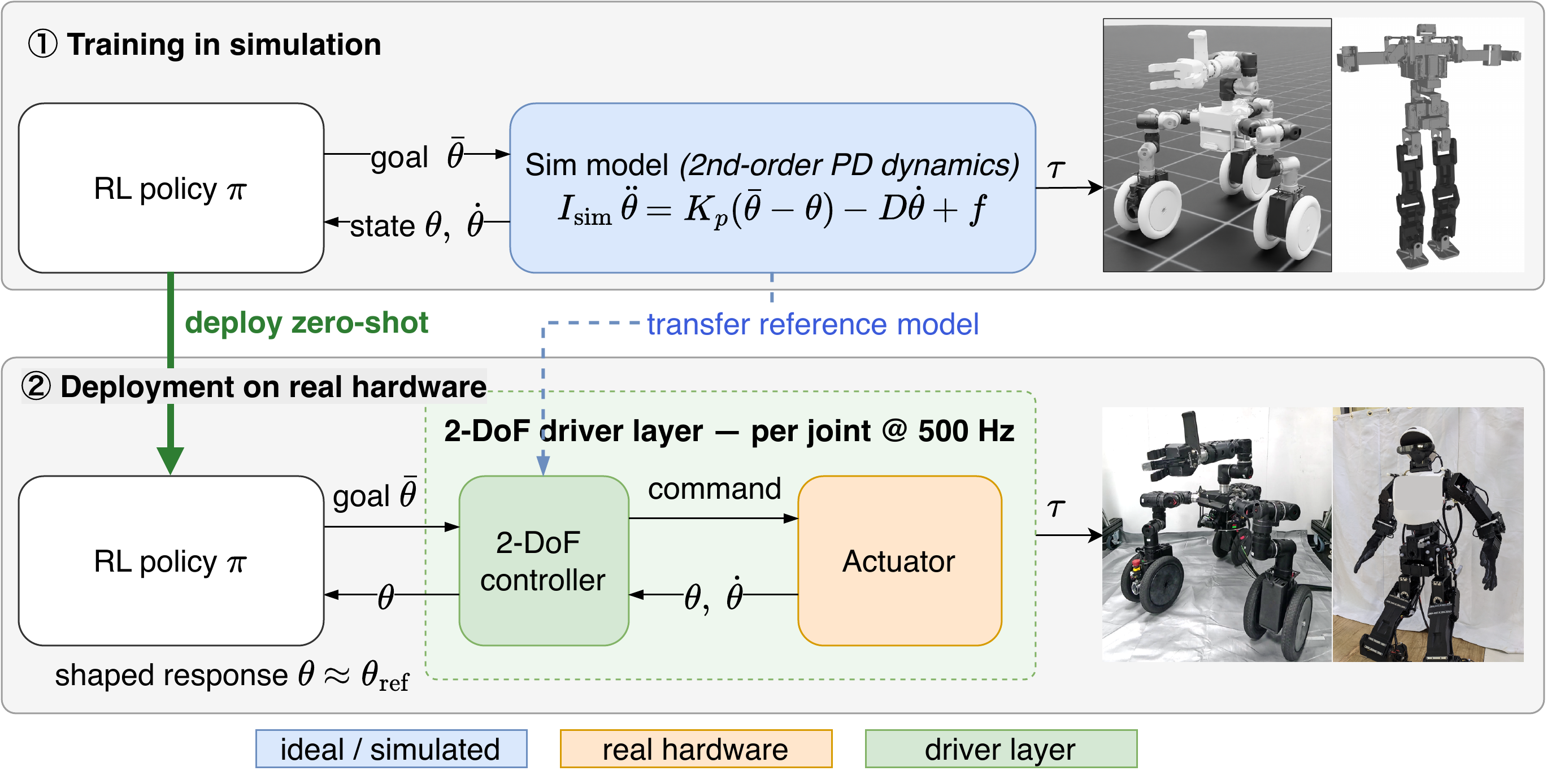
Existing sim-to-real methods try to identify the hardware so the policy can adapt to it. We take the dual perspective: we shape the hardware's closed-loop response at the driver level so the policy perceives a fixed, simulator-defined plant on every platform. Even high-gear-ratio joints emulate the ideal reference plant, with residual error absorbed at runtime by a disturbance observer and integral feedback.
Contributions
- We introduce the actuator reality shaping paradigm and derive a 2-DoF control architecture that shapes the closed-loop actuator response to match a prescribed simulator reference model.
- We validate the architecture on single-joint tracking with disturbance injection and demonstrate zero-shot sim-to-real transfer on a 7-DOF arm reaching task, comparing against the factory cascaded servo, a tuned PID, and a learned Delta-Action baseline (ASAP).
- We further demonstrate generality via zero-shot transfer on a wheeled-legged robot and a full humanoid robot performing forward walking.
Method: 2-DoF Controller + Disturbance Observer
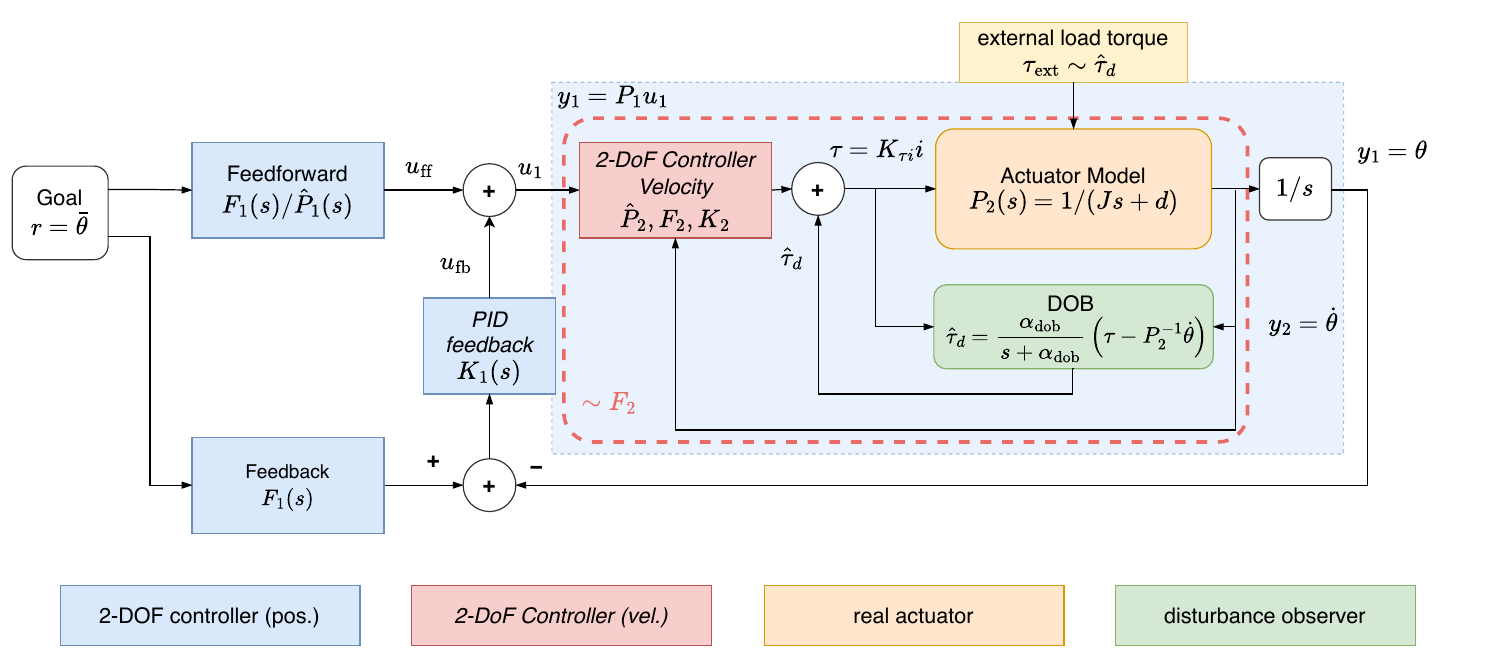
The feedforward path specifies the desired closed-loop dynamics seen in simulation; the feedback path (PID with integral action) compensates for disturbances and residual actuator-model mismatch. The DOB attenuates the residual model error ΔP below its cutoff, absorbing unmodeled friction, cogging, and external loads.
Zero-Shot Demonstrations
The same per-joint 2-DoF driver layer transfers to platforms with very different actuators and dynamics, without task-level tuning or learned actuator models.
Humanoid: Forward Walking
22-DOF humanoid using PH54 servos. Trained with the BeyondMimic framework in simulation, deployed zero-shot — the only change is the actuator model swapped for the ideal reference plant.
Moonbot-mini: Slope Traversal
31-DOF wheeled-legged robot climbing a slope with poorly backdrivable YM070 servos. The 2-DoF controller reproduces the simulator's compliant spring-damper behavior, enabling zero-shot transfer.