Research interests
- Reinforcement learning
- Imitation learning
- Robot motor control
- Sim-to-real transfer
- Hierarchical reinforcement learning
- Phase-amplitude reduction
Vision
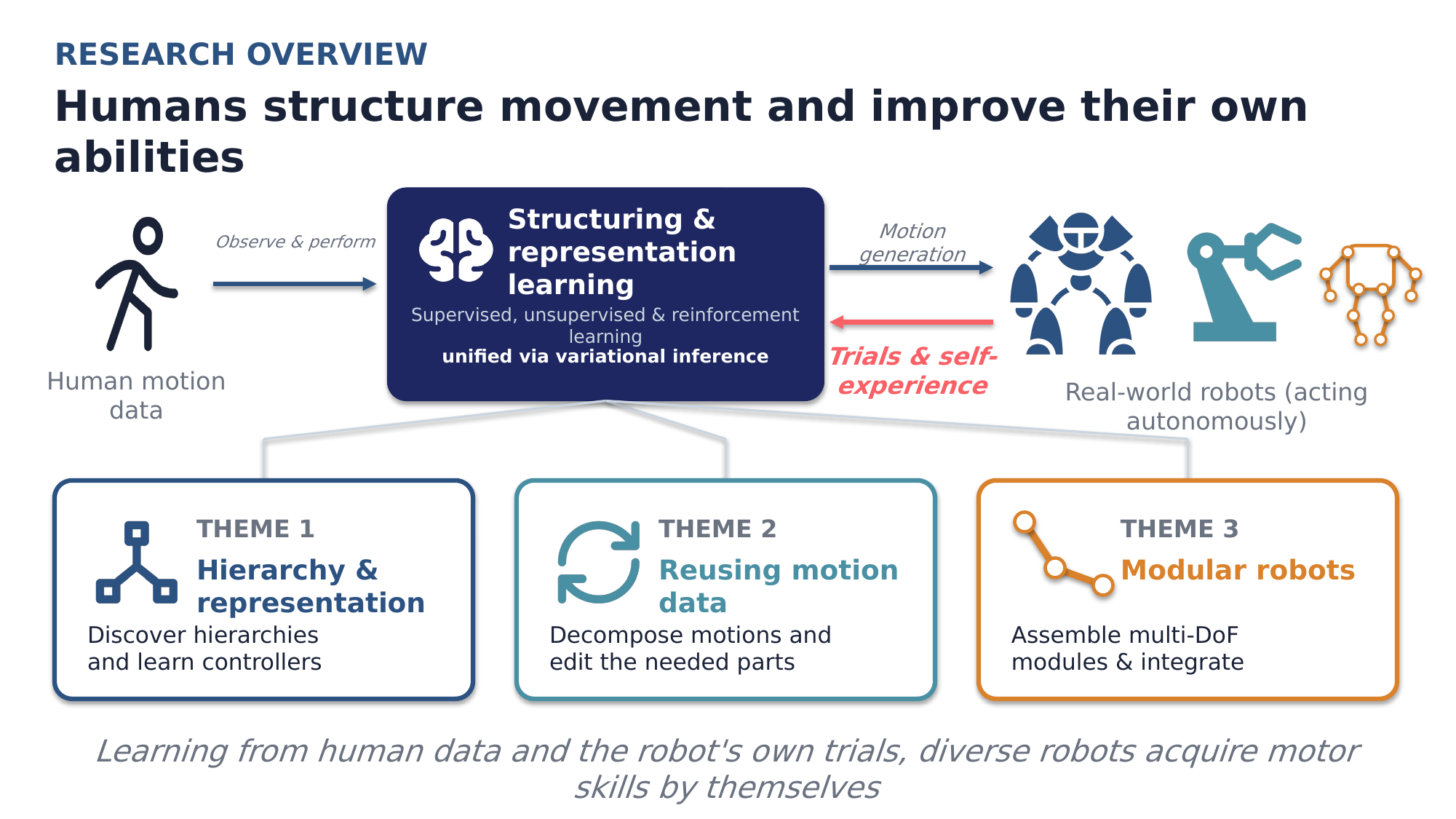
Robots that move around on their own, acquire a variety of motor skills, and grow much like humans and other living beings — realizing such AI is one of the outcomes people expect most from robotics. Following the success of LLMs, Physical AI — AI that operates in the real world — has been attracting growing attention, yet its realization is far from straightforward and a long road remains before practical deployment.
The essential challenge lies in the scarcity of structured data. Language, despite its exceptions, is regular data segmented into word units by grammar. Physical phenomena in the real world, in contrast, interact in complex ways across a wide range of temporal and spatial scales, from micro to macro, making it difficult to uncover their structure. For an agent to generate its own goals from such data and act on them, supervised learning from labeled examples alone is not enough. Frameworks for unsupervised learning, which structures data on its own, and reinforcement learning, which collects data through the agent's own actions, become indispensable.
Building on variational-inference-based reinforcement learning as a mathematical methodology, I research and develop motor control technologies for robots operating in the real world, combining the fundamental machine learning paradigms of supervised, unsupervised, and reinforcement learning.
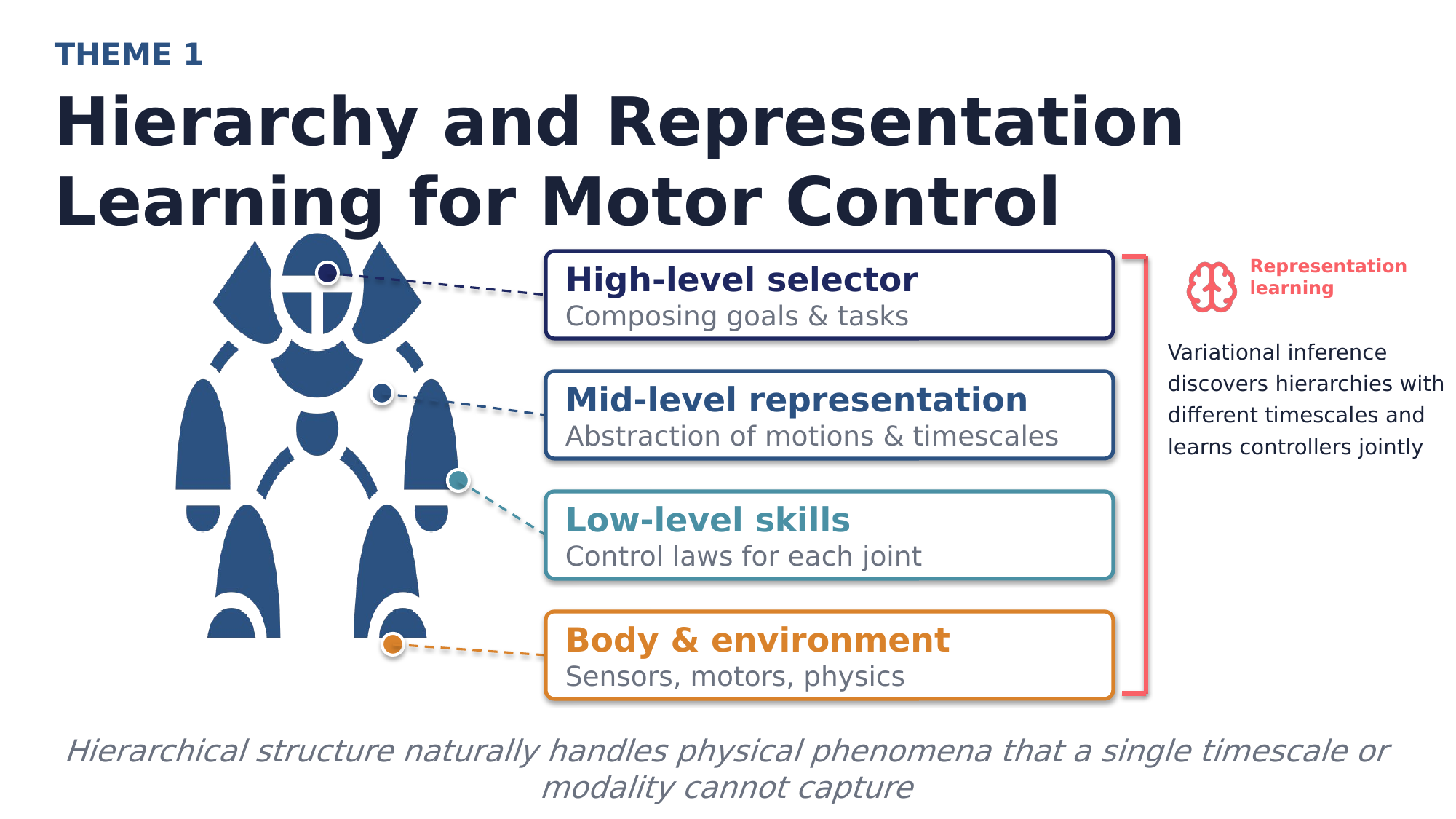
Hierarchy and Representation Learning for Motor Control
Policy learning with a single timescale and modality alone cannot fully capture real-world physical phenomena. What is needed is a "natural" hierarchical structure that separates low-level skills, independent of task and embodiment, from a high-level selector that combines them. Using a variational-inference framework, I pursue methods that naturally discover hierarchical structures with different timescales from data while simultaneously learning the controllers at each level.
Related publications: Artificial Life and Robotics 2025, ICRA 2026
Reusable Motion Representations from Motion Data
After learning a motion from data, there are many situations where we want to modify its characteristics — such as playing it back faster or slower — or apply it to a different task objective. Relearning from scratch every time the objective changes, however, is not practical. By decomposing motions into their constituent elements during learning, we can later edit only the necessary parts of an acquired motion, or extract skills and recombine them in new situations. Through such reusable representations, I aim to enable adaptation with only a small number of trials.
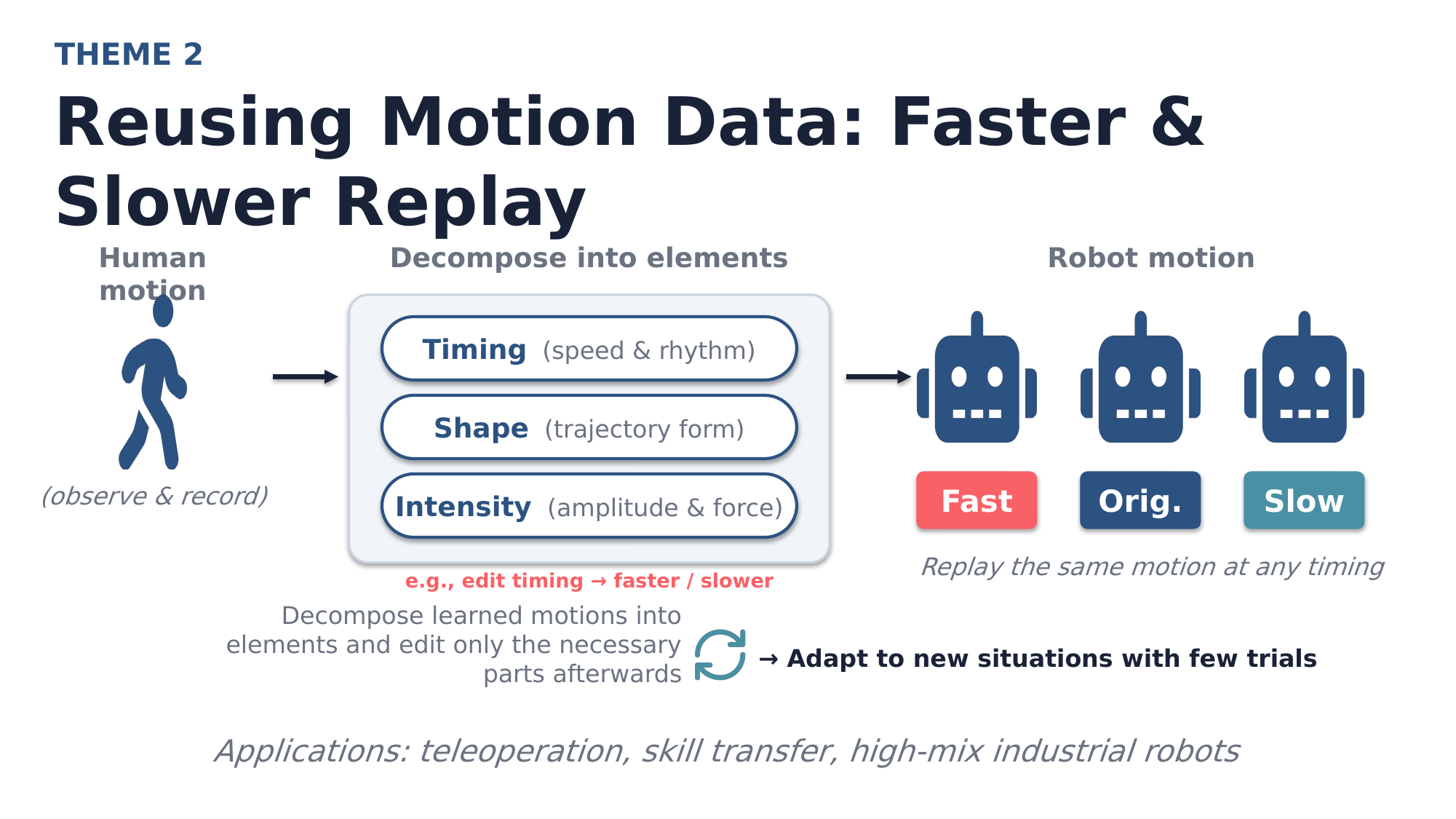
The videos below show an example in which a motion is learned from a human demonstration (left) and replayed at normal speed (center) and at double speed (right). By editing only the timing afterwards, we can change the motion speed without any retraining.
Related publications: Advanced Robotics 2025, IEEE T-CDS 2025, Humanoids 2025
Reinforcement Learning for Modular Robot Control
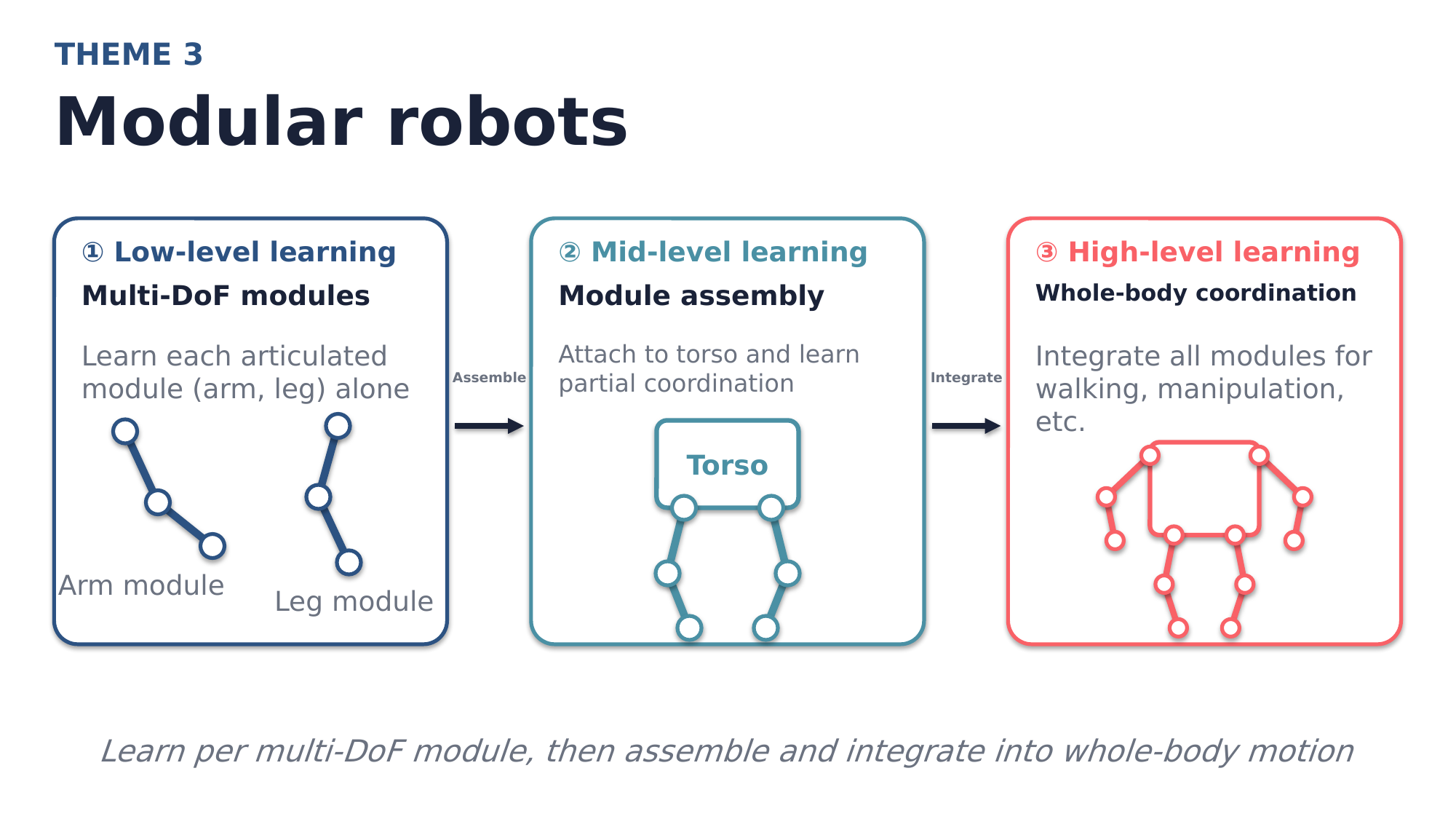
Robots whose morphology changes by attaching and detaching modules become increasingly complex as more modules are combined, making it difficult to compose their motions. I pursue a framework that learns motions incrementally for each multi-degree-of-freedom module — such as an arm or a leg — and combines the lower-level learning results at a higher level to generate motions for diverse morphologies. I envision applications to self-reconfigurable robots in areas such as lunar exploration and disaster response.
Related publications: Artificial Life and Robotics 2025, CASE 2025, ICRA 2026, IROS 2026